

Pisco Punch
Pisco Punch was a popular drink during the gold rush, especially at the Bank Exchange Bar which, if it wasn’t the drink’s birthplace, became the site of its popularization. This drink, which applied the already centuries-old punch template to a brandy all the way from Peru. I took a few liberties with our recipe, but the spirit of the original shines through.

49er Smash
The California gold rush created an incredible demand for all kinds of goods that the Bay area didn’t yet have the infrastructure and stock to provide. Coffee was one such commodity and its price skyrocketed as coffee merchants sought to make big profits off the miners’ newfound wealth. I imagine that the miners would have spiked their expensive coffee with a bit of whiskey and sweetened it with pricey sugar and vanilla, too.

Colombe II
Paul Girault’s original Colombe cocktail, served at Café de La Paix, was a modified Champagne cocktail fortified with Cognac and cherry and orange liqueurs. I’ve adapted it to suit our supply list this month, keeping the Cognac and orange liqueur, using grenadine to hint at the conflation of grenadine and cherry syrup, and “improving” the mixture with absinthe and Angostura bitters. The snifter is a nod to the Cognac base.

Sidecar du Roi
A sour that was popular at the Ritz Bar in Paris in the 1920s, the Sidecar traveled across the Atlantic and became a favorite drink in the U.S. during Prohibition. I took the spec developed by Ned King (get it? roi!) at Gigantic, which uses honey syrup in addition to orange liqueur; I decided to embrace the traditional sugar rim garnish, giving it dimension by adding chamomile.

Normande 75
The French 75 is traditionally made with Cognac or gin, lemon, sugar, and Champagne. I favor the Cognac version–which lives on as a New Orleans classic. I thought it would be fun to make a version inspired by Normandy, using Calvados in place of Cognac and, mirroring the grapes-on-grapes dynamic of the original, to pair the French apple brandy with dry cider in place of Champagne.

Jacqueminot Rose
The Jack Rose wasn’t invented in Paris, but it made a name for itself in the French capital’s expat scene. Though several versions exist, at times including orange juice, liqueurs, or vermouth, the version from Hugo Ensslin’s 1917 Recipes for Mixed Drinks is elemental and delicious. Our version calls on two French brandies–the Calvados as a nod to the American apple brandy of the original, and Cognac–along with a little absinthe for dimension.

A Twenty-First-Century Cocktail
Spirit-forward drinks were stars of the Cocktail Renaissance–and they haven’t strayed much from the formula that was set over 200 years ago. This recipe reflects the resurgence of “old-world” spirits like Cognac and genever as well as the return of rye as a base for cocktails. The bitters in this Old-Fashioned come in the form of amaro, a darling of contemporary American cocktail culture. This drink harkens back to my Al-Pino Old-Fashioned recipe, which I developed in 2018 (original) and 2021 (2.0) respectively.

The Old-Fashioned
When, in the post-Civil War era, Fancy & Improved Cocktails came on the scene followed by the Vermouth Cocktail and Manhattan, people needed a way to order the more elemental Cocktail and the term “Old-Fashioned” was applied to the simple spirits-sugar-water-bitters formula. This version is an attempt to capture what happened to the Cocktail during the twentieth century–we stop short of muddling fruit but cherry syrup and stirring with an expressed orange peel give it a subtly similar effect. Rye and bourbon are both popular bases for this iteration of the drink.

Fancy & Improved Cocktail
By the 1860s, it was common practice to add liqueurs–Curaçao and maraschino in the early days–to the Cocktail’s original formula. The term “Fancy Cocktail” typically denotes this addition and the assurance of a lemon twist, too. “Improved Cocktails” typically layer yet more flavor, with absinthe, multiple liqueurs, or a combination of bitters. The recipe below is technically an Improved Cocktail, though omitting the absinthe will knock it down to the “Fancy” level.

The Cock-Tail, or Bittered Sling
The drink from which so many have sprung–the Cock-Tail originated in the late eighteenth century and, by 1806 was codified as a “bittered sling,” i.e. a combination of spirit, sugar, water, and bitters. The method of preparing the cocktail without ice yields a cool but not ice-cold drink, allowing the character of the Holland gin (genever) or French brandy (Cognac) to shine.

New Year’s Eve 1951
Call me old-fashioned, but I love Champagne for New Year’s. Is there anything more classic? Though I do like classic Collins-esque Champagne cocktails like the French 75 (especially the Cognac-based kind), a stirred, spirituous base topped with bubbles is more my speed. This one is somehow wintry and tropical all at once, and ever-so-festive.

Fruit Basket Punch
What ever happened to the fruit basket? There’s a very striking cover on the December 1947 edition of Gourmet that features a big fruit basket, ham, Champagne, and cigars in front of a Christmas tree. This punch is my attempt at an ode to the once-prized Christmas tradition, the noble fruit basket.

Auld Lang Syne Eggnog
I have a deep appreciation for eggnog (and its cousin, Tom & Jerry). Because of my fondness for the holiday classic, I’ve developed several recipe for eggnog over the years, both large-format and single serve. This one combines two of my favorite versions–one with rum, rye, and Cognac and one with sherry and Madeira–and streamlines it into a single-serving variation that has a classic flavor profile with a dried fruit note.
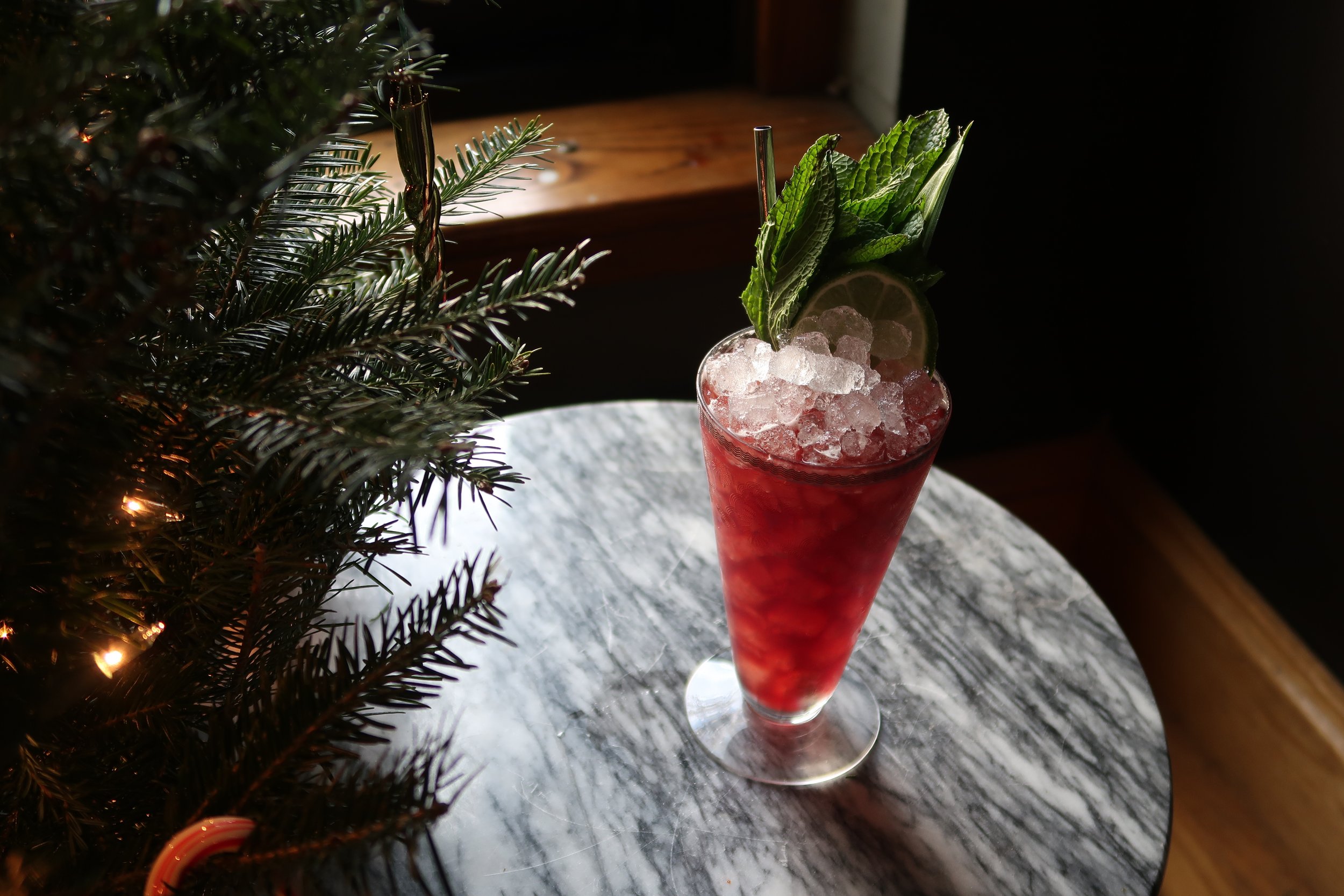
St. Nick Sangaree
I love the classic idea of having nuts, chocolate, and dried fruit with coffee and port after dinner. For this recipe, I leaned on the idea of Sangarees and Cobblers, layering flavors over a tannic base and drying the whole thing out with a half-ounce of rye. Pebble ice and a very Victorian garnish make this one quite festive indeed.

Jack Frost Fizz
The very first cocktail recipe in William Schmidt’s sprawling entertaining and drinks manual is the Jack Frost Whiskey Sour. It calls for “apple whiskey,” cream, a whole egg, sugar, lemon, and soda. In actuality, it’s a Fizz and our version plays that up and splits the spirit and sweetener elements across a few different spirits and liqueurs. Juniper, apple, fig, and honey come through in this creamy, Flip-adjacent Fizz.

Dizzy Does New York
This honeyed apple brandy Sour is a combination of a Dizzy Sour and a New York Sour. The New York Sour, as you likely know, is a rye whiskey Sour with a dry red wine float on top. The Dizzy Sour is far more obscure; it debuted in The Hoffman House Bartender’s Guide and consists of rye, Bénédictine, sugar, and lemon, with a rum float, when combined with the New York Sour, subbing in apple brandy and adding a touch of fig syrup, the result is a honeyed, tannic drink with citrus and dried fruit notes.

Bitter Widow’s Kiss
The Widow’s Kiss was first published in 1895’s Modern American Drinks by George Kappeler. The original recipe calls for apple brandy with equal measures of Bénédictine and yellow Chartreuse, plus Angostura bitters. Our take is dry and spirit-forward and switches out the Chartreuse in favor of Alpine amaro, which nods to the Alpine origins of Chartreuse and also does the work of the bitters. It’s got a Rusty Nail vibe that I really love.

Motor Wagon Cocktail
A stirred drink from The Hoffman House Bartender’s Guide (1905), the Automobile Cocktail consists of equal parts Scotch, Old Tom gin, and Italian vermouth, plus a little gum syrup and orange bitters. I took this template and subbed in apple brandy for the Scotch, using alpine amaro in place of bitters, and sweetening with fig syrup. It’s Martinez-esque, but feels perfect for November with apple and pronounced piney notes. “Motor wagon” was a term used by some early car makers.

Conway Milk Punch
Milk Punch–the kind we now differentiate as “clarified”–goes back to at least the early eighteenth century. It’s made by curdling warm milk in a punch mixture then straining it and, thanks to the magic of science, the milk solids make the mixture clear (hence the term “clarified”). Ours has aged rum, Madeira, lime, green tea, sugar, spices, and, well, milk.

Hilltown HBR
Hot Buttered Rum is a drink that has, blessedly, survived into the twenty-first century thanks in large part to its popularity around the holidays. At its most elemental, it’s just rum, sugar, spices, butter, and hot water. I didn’t want to make this variation too overly complicated, but the walnut liqueur, as well as the pumpkin and miso flavors in the syrup, amp up all the best parts of this simple classic while giving it a bit more dimension.