

Wassail
‘Wassail’ comes from the Middle English wæs hæil, and from the Old Norse before that ves heill meaning something akin to “be you in good health.” This classic medieval beverage, typically made from a combination of cider, ale and, later, fortified wine, has great significance in English drinking history and was popular during the Tudor period. ‘Tis truly supreme with the eggs, but if you must omit them for dietary reasons, ‘twill be delicious all the same.

Capitaine of Mischeefe (large format)
Back in 2020, I developed a series of three drinks for my Lords of Misrule series, including this recipe, which was originally a single-serving punch. Its ingredients tell the story of the late Tudor (i.e. Elizabethan) period, when the English became the dastardly colonizers we now know them to be. In this large-format version, brandy (either Spanish or French) comes together with funky Batavia arrack (the original punch base!), oxidized sherry, Swedish Punsch (a punch within a punch), allspice dram, tea, and sugar for a punch with notes of dried fig, tropical fruit, nuts and spices, and a hint of smokiness.
Rusty Godfather
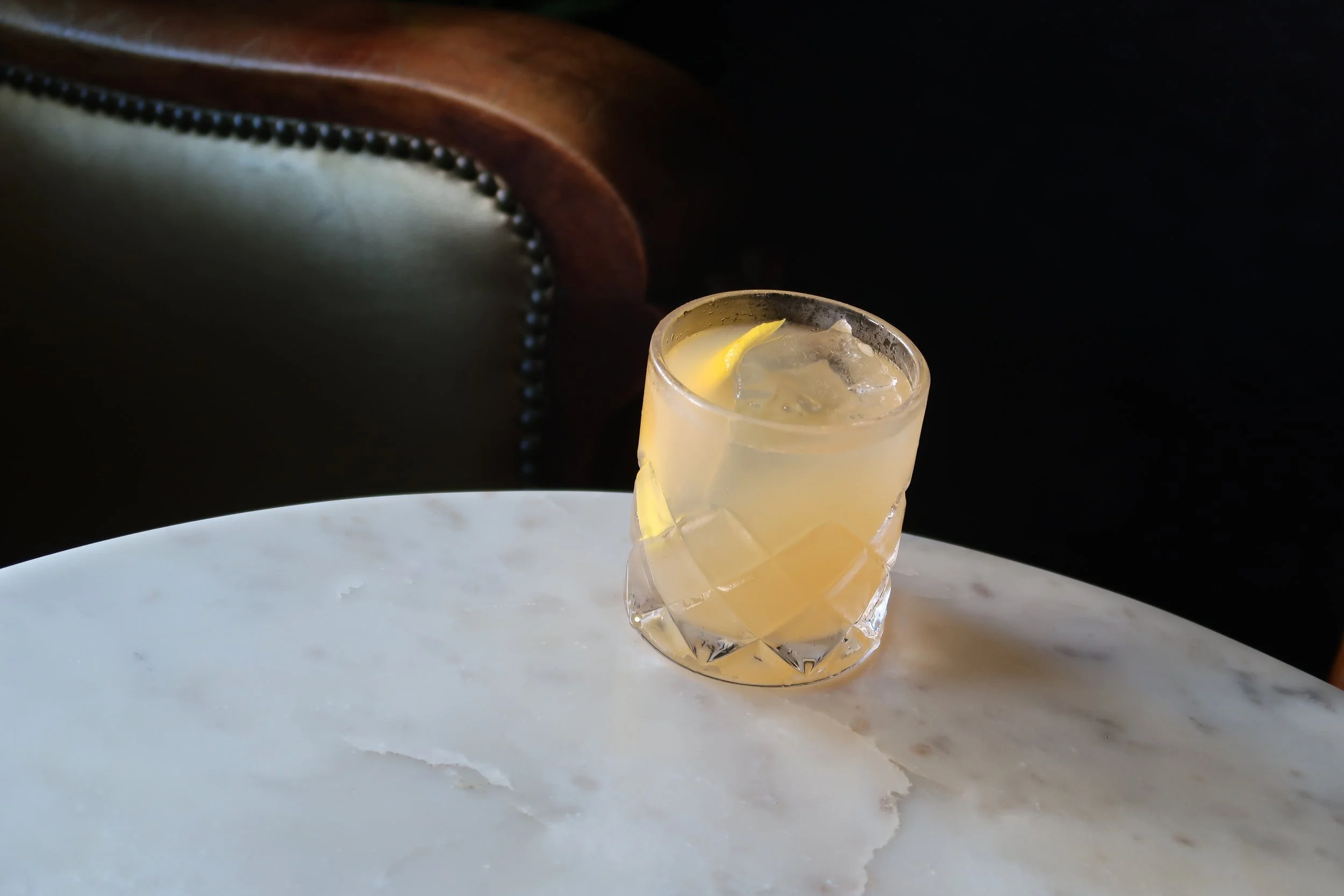
As I was developing this month’s recipes (originating with the Isle of Skye and Cameron’s Kick), I saw the potential for a Rusty Nail-Godfather “mash-up” that would please any fan of stirred, spirit-forward drinks. The resulting cocktail is the best of both worlds–heather and honey from the Drambuie and nutty almond flavor and texture from the orgeat. Though both are associated with the postwar “bachelor drinks” boom, the Rusty Nail dates to the 1930s, far before the birth of the disco-era Godfather.

Tailor’s Flip
I wanted to do a fizz for this month (I do so love a fizz!), but all the combos I tried fell flat! Instead, I decided to eliminate the soda element and incorporate a whole egg instead of just egg white, making it a classic nineteenth-century flip. The resulting cocktail, with smoky, spiced, and tropical flavors is an excellent dessert drink befitting any cold-weather gathering.

Isle of Skye
I developed this drink for Gigantic’s Fall 2023 menu; the original recipe called for genever but, as I’ve often likened the Dutch spirit’s gentle maltiness to that of Irish whiskey, this month’s supply list set the stage for an easy substitution. This sour’s blend of citrus, banana, spices, and honey bolstering the malty and peaty spirits makes for a delightful ode to the birthplace of Drambuie.

Cameron’s Kick
The Cameron’s Kick is a 1920s London classic invented by Harry MacElhone at Ciro’s. He brought it to Paris a couple years later, when he bought the bar at “sank-roo-doe-noo” (5 Rue Daunou) aka Harry’s New-York Bar. The spec published here is how we make it at Gigantic, with a split base of blended Scotch and Irish whiskey with the drink’s classic one-two punch of lemon and orgeat plus Angostura bitters and a float of peaty single malt.

Calibogus
One of many ale-based proto-cocktails popular in eighteenth-century American taverns, I like to think of the Calibogus as the piney cousin of the Rattle-skull. The original Calibogus would have been a simple mixture of rum and spruce ale (a popular antiscorbutic for sailors), possibly flavored with lime juice and a sweetener like molasses. I decided to adapt this recipe by using ubiquitous, hoppy IPA for the ale component and an apple brandy base because it marries nicely with the ale and citrus.

Montague Mull
Shrubs were a popular method of preserving fruit in New England during the eighteenth and early nineteenth centuries. Though almost all apple cider in those days was fermented, I saw an opportunity here to build a non-alcoholic drink reflecting this month’s historical milieu with sweet, non-alcoholic cider, cranberry shrub, and our ginger-molasses syrup, with lemon juice to bolster the acid and salt and cayenne to liven things up.

Black Strap
Sometimes called Black Stripe, this drink is a toddy-like mixture of rum, molasses, and hot or cold water that comes from the same seafaring roots at Calibogus (and, indeed, early versions at sea contained spruce ale). Blackstrap was one of the most popular tavern drinks of the late eighteenth through mid-nineteenth centuries in rural New England. Our version uses nineteenth-century techniques to revive this forgotten Rum Old-Fashioned ancestor.

Hot Apple Toddy
This drink is another that was emblematic of American culture in the days of the early Republic but has since been forgotten. Popular in winter, as they were traditionally served hot, Apple Toddy recipes, including the one in Jerry Thomas’s 1862 book, typically call for mixing apple brandy with hot water and baked apple, and topped with nutmeg. Our version is a little more complex, with notes of cranberry, vanilla, spices, and ginger.

Midcentury Sour
The Whiskey Sour was one of the vestiges of nineteenth-century mixology to survive Prohibition and experience broad popularity during the postwar period. This is my take on what a really good bourbon-based sour reflective of that period should be with the iconic orange-and-cherry garnish. If you make it with vanilla syrup, it’s got a really nice, subtle creamsicle flavor; egg white advised.

Boston Sour & Rattlesnake
Whiskey Sours with egg white came into favor in the 1920s, almost certainly a product of the vibrant cocktail scene that flourished overseas during Prohibition. It has been called the Boston Sour by some, including, unsurprisingly, the Old Mr. Boston Official Bartender’s Guide, first published in the 1930s. The Rattlesnake, a Savoy Cocktail Book drink, is a Boston Sour with absinthe.

New-York Sour
The Whiskey Sour with a red wine float (aka a “claret snap”) has gone by various names including the Continental Sour and Southern Sour and, though it likely originated in Chicago, people in 1880s Boston called it the “New-York Sour,” and the name has stuck. It can be served over a large ice cube or up in a chilled coupe; at Gigantic, we favor the former.

Whiskey Fix
Though the Sour template predates the Fix slightly, the latter–a Sour served over crushed ice–was an incredibly popular member of the family in the mid-nineteenth century. Our recipe is diluted with a measure of water, just like the earliest extant Fix and Sour recipes–a nod to their evolution as a single-serving punch.

Pollard Ice Punch
A menu for Othello Pollard’s Boston restaurant from 1803 listed Solid Arguments (foods), Agitations (acidic things), Grievances (spicy things), Superfluities (sweets) and Punishments (alcohol). Under punishments one finds “ice-punch,” a version of the already very entrenched crowd-pleasing drink served on the new craze: ice. Below is our imagined vision of what may have been in that punch.

Alexander Hail-storm
There are two schools on the history of the Hail-storm and my suspicion is that they have both been true and different points in history. One is that “Hail-storm” is just another term for a Mint Julep, and the other is that the drink was sweetened brandy served over ice. I opted to explore the latter here, making it a nice chilled capital-C Cocktail–a drink that otherwise remained room temp for much longer than contemporaries like the Cobbler, Fix, etc.

Downing Cobbler
Like many of the Black culinarians we’re learning about this month, Thomas Downing was not considered a bartender, but a restaurateur who ran an oyster cellar and catering business. But we know he served drinks at his establishment and, as Cobblers were the order of the day, I opted to create one with Madeira and brandy which were en vogue in New York City during Downing’s heyday.

Dabney Julep
John Dabney was so famous for his Mint Juleps that his obituary claimed that he “concocted more mint juleps than any man in the country.” His were rye-based, piled high with crushed ice and garnished with abandon. One description of a Dabney Julep listed mint, a strawberry, cherry, a slice of pineapple, and a pink rose as garnishes.

Melon Delight
For this month’s theme, I took a look at the food menus at Borscht Belt resorts–drink menus are generally more ephemeral or nonexistent and hard to find–and even though the words “melon delight” didn’t appear, I thought they’d fit right in. This drink’s kind of an oddball as far as its construction, but it works and is exceedingly refreshing.

Midge Maisel’s Martini
Say what you will about The Marvelous Mrs. Maisel, but the episodes that take place in the Catskills are a feast for the eyes and a window into what these Borscht Belt resorts looked like. Though, as you know, I like my martinis with gin and a ratio of 2:1, I wanted to create a dry martini with a strong herbal quality… and a vodka base. The dill infusion works really well here.