

Barnstable Punch (for a crowd)
As you may have noticed, I favor aged spirits in most things and especially in punches. But a great gin punch is a welcome addition to any gathering, so I’ve done the math on my popular Barnstable Punch from last year’s Yuletide class. You can use just London dry gin, just Old Tom gin, or a mix of both as I’ve suggested here, just be aware that you may want to adjust to taste.

Janus
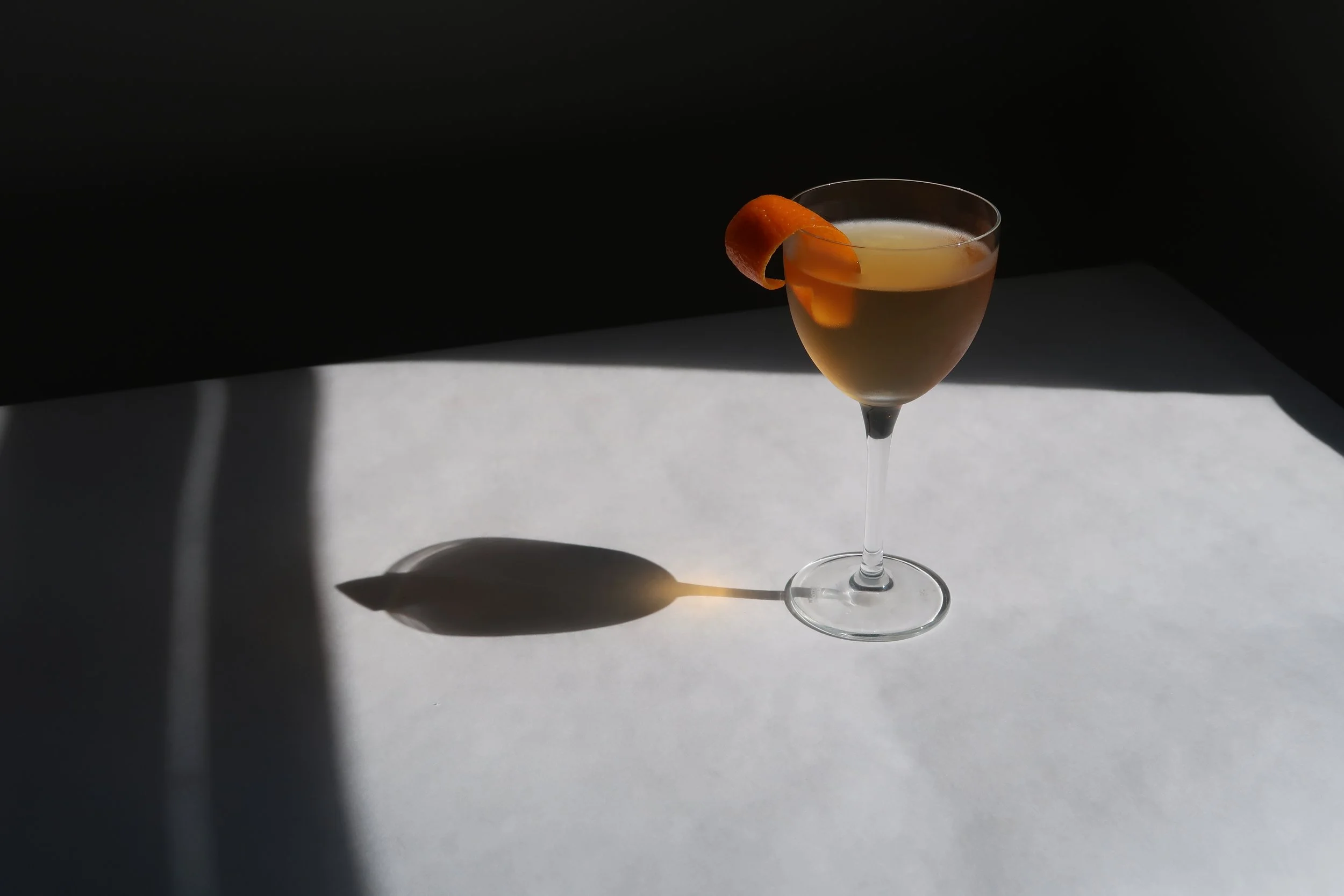
I’m doing a yearlong series for Keap, a maker of fine candles based in Kingston, NY. It’s been a really fun project to work on, especially because they let me design the drinks around the Labors of the Month, a cycle common in medieval art that I’ve long been obsessed with. Here’s the recipe for January 2022, a stirred Cognac and amaro cocktail topped with Champagne.

Rumbold Reviver
If you were around for Scotch month back in February, you’ll know that I love smoky flavors with grapefruit. This drink takes its structure from the Corpse Reviver No. 2, but borrows the Diki-Diki’s unique combination of Calvados, punsch, and grapefruit. I named this one after Gilbert Rumbold, who illustrated The Savoy Cocktail Book.

Le Mans
I’m not a huge fan of the oft recycled origin stories for cocktails, but I have a soft spot for the one behind the Bentley, which inspired this cocktail. The British racing team won Le Mans in 1927 and the celebration at the Savoy included a signature cocktail built on Calvados and Dubonnet rouge. I took the original formula and added dimension with flavors of juniper, tea, citrus, and black pepper.

La Pomme Fumée
Strong, stirred drinks featuring multi-spirit bases are all over The Savoy Cocktail Book. This one was particularly inspired by the Twelve Miles Out cocktail, which featured Calvados, Bacardi rum, and Swedish punsch, and was named for an American silent film that debuted in 1927. Ours is a smoky apple tribute to the stirred and strong drinks served at the Savoy, hence the name.

Calva-Quina
Here’s a nice little aperitif with multiple inspirations behind it. It’s an ode to the apple brandy highballs from The Savoy Cocktail Book, but also pays tribute to the Norman tradition of Calva-Tonic. We double up the quinine in this version, which gets its tannic baseline from rouge quinquina.

Portsmouth Punch
Tavern culture was deeply tied with ports, in part because some of its most notable drinks were born at sea, but also because so much of taverns’ stock was imported. The combination of rum and brandy was a common one in eighteenth-century punches, and Madeira was a wildly popular imported wine. Our punch is flavored with a plethora of other valuable imports: spices, ginger, lime, and tea.

Rattle-Skull
The flip began as a sailors’ drink and swiftly infiltrated the taverns of England and “British America.” There, it became a hot drink ー a mixture of ale, spirit, egg, sugar and spices, and sometimes other ingredients. Flips were warmed and frothed by submerging a hot iron poker, called a flip-dog or loggerhead, that had been heated in the tavern hearth. If you’re “at loggerheads” with someone, try offering them a mug of this ー ‘tis hard to stay angry with such a comfort in hand.

Medford Bumbo
Bumbo, or “Bombo” is a rum sling sweetened, diluted spirit flavored with spices. Rum was a major force in eighteenth-century life, whether it was imported from the Caribbean (that was the best stuff) or produced locally in New England from molasses, the most famous of which was produced in Medford, Massachusetts. Like the whole toddy-sling family, Bumbo is among the nearest antecedents of the capital-C Cocktail.

At Loggerheads
The flip began as a sailors’ drink and swiftly infiltrated the taverns of England and “British America.” There, it became a hot drink ー a mixture of ale, spirit, egg, sugar and spices, and sometimes other ingredients. Flips were warmed and frothed by submerging a hot iron poker, called a flip-dog or loggerhead, that had been heated in the tavern hearth. If you’re “at loggerheads” with someone, try offering them a mug of this ー ‘tis hard to stay angry with such a comfort in hand.

Al’s Manhattan Challenge
I’m challenging you all to come up with your own house Manhattan; or a new favorite Manhattan; or your fall 2021 Manhattan! Whatever you’re seeking, I hope these guidelines help you find it.
Two Stars & A Wireless
Apple brandy Manhattans are one of the most delicious (and fall-appropriate) branches of the family tree. We have a great triumvirate here: the dry Star (Harry Johnson, 1900), the sweet Star (George Kappeler, 1895), and the Marconi Wireless (Old Waldorf Astoria Bar Book, 1935).

1914 Manhattan
The Manhattan was a disparate, but powerful, force for the first thirty or so years of its existence. In the years just before Prohibition, and through the ‘30s, the recipe begins to solidify its 2:1 ratio, the bitters overwhelmingly Angostura, and the garnish is usually a cherry.

1888 Manhattan
The earliest versions of the Manhattan resemble quite closely the original Cocktail (spirits, sugar, water, bitters) and feature a split base of rye and Italian (sweet) vermouth. This is an excellent example, taken from the second edition of Harry Johnson’s Bartenders’ Manual.
Rob Royale
This is the cocktail I came up with on the spot during our September 2021 video shoot when I realized I hadn’t developed a recipe to use as the example for the Manhattan Challenge. Love it to this day and still make it!

Pineau des Charentes & Pommeau de Normandie
Both of these beautiful products are mistelles, which are produced by adding unfermented or partially fermented juice to full-proof spirit (typically in a ratio of 3:1 juice to spirit) and barrel aging it. Pineau des Charentes is produced in the same region as Cognac and combines unfermented grape juice with 1-year-old Cognac. Some are bright and lively while others have earthier, dried-fruit notes. The Pommeau is produced similarly, but in Normandy, an apple-rich coastal region in the northwest. It’s typically 75% unfermented apple juice and 25% Calvados and delivers not only big apple flavor but a wonderful texture as well.

Pastis
Gaëtan Lassale is one of my oldest friends. We studied in Canterbury, England, together back in the early aughts. Gaëtan grew up in a village in the south of France, eating dinner with his family on the terrace every night in the summer. They ate lots of grilled meat and vegetables, along with ratatouille and aubergines in tomato sauce, which were prepared in the cooler morning hours and served cold in the evening. His grandmother liked to beat the heat by drinking the anise-flavored spirit pastis with chilled water ─ a popular drink in Marseille.

Olivier
Last year I had the good fortune of connecting with Zac Overman, who sent me a copy of Cocktails a L’Américaine, a compilation of L’Oursin’s house cocktails. The book is full of complex drinks rooted in American mixology that utilize the best of French and alpine spirits, wines, and liqueurs. But because of our August theme, I chose to feature this elegant bitter highball, which showcases the style of French drinking we’re celebrating this month. It’s named after the Corsican cheesemonger who supplies L’Oursin.

Kir-Any-Way
My friend Rebekah Peppler has a talent for transporting her readers to France. Her books, Apéritif and À Table give us a window into her life in Paris and highlight traditional French food and beverage. When I was perusing her books for this month’s programming, I noticed that her collection of Kir variations is like a mini road trip through France, from Normandy and Brittany to Burgundy, Paris, Champagne, and beyond. So, grab a bottle of crème de cassis, choose your variation(s), and be transported!

Lockport Sling
This one’s basically a sparkling sling with a little pop of acidity from the cordial. The combination of cherries and baking spices reminds me of eating cherry cobbler (or pie!) outside toward the end of a long summer’s evening.